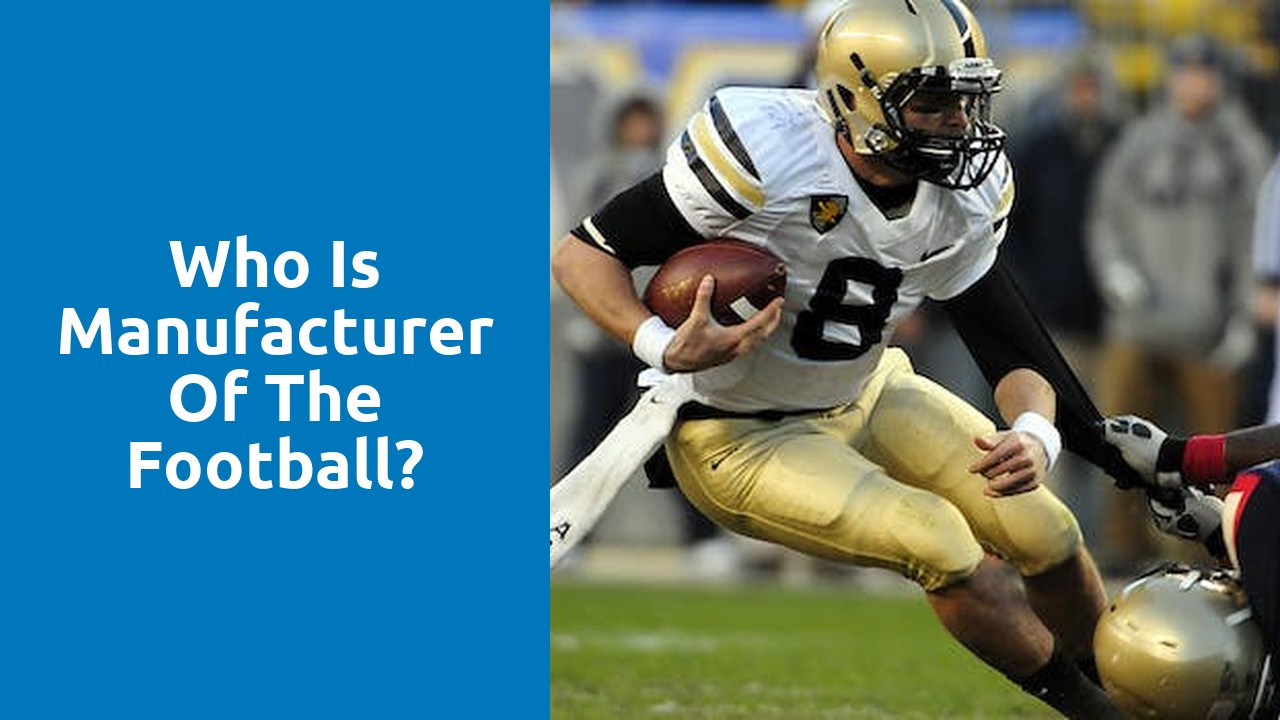
Puma was the first company to start manufacturing footballs, beginning in 1908. However, the company did not sell products under the brand name “football” until the 1950s. Before that, the brand was called Spoor, which is Dutch for “sports ball.” The first-ever ball to bear Puma’s logo was presented to FIFA’s first president, J.T. Mann, at the 1924 FIFA Congress.
The manufacturer of the football is chosen by the NCAA, and is responsible for producing the official footballs used during the college football season.
The NCAA has been using the Wilson brand since 1940, and the company also produces the game ball for the National Football League. The NCAA also partners with Wilson to help design the football, including the size, weight, and materials used.
Each school is required to submit its specifications for the footballs and any additional equipment (such as for kicking or punting) to the NCAA.
While the NCAA allows any brand of football to be used, only a few brands are chosen by the teams that compete in the NCAA. The NCAA allows five different brands of footballs to be used in competition: Wilson, Wilson Tech, Spalding, Bauer, and Under Armour. While each brand has slightly different characteristics, they all meet the same standards.
The NCAA then accepts or rejects each school’s request for a specific model.
Every football manufacturer is different. Some companies use rubber, while others use plastic. Some use foam, while others use leather. The NCAA recognizes that each type of football is different in its properties and impact. The NCAA also recognizes that each manufacturer builds the ball differently. The NCAA reviews the construction of a football model submitted by a team in order to make sure that the ball meets NCAA specifications regarding weight, size, and the materials used to make the ball.
Once the NCAA approves a team’s request, the manufacturer makes the required number of footballs for that school and ships them to the school.
The NCAA has authorized the Wilson Sporting Goods Company to be the exclusive provider of NCAA footballs from 2007 to 2023. Wilson has made footballs for college teams since 1982. If you want to see how the Wilson logo looks on a football, visit the official NCAA website.
The NCAA allows each school to keep a certain number of the approved footballs for use during the season.
The NCAA allows each school to use a single brand of football. The NCAA has a list of approved manufacturers and each school is required to purchase its footballs from this list. If a school decides to use a different brand of football, they must submit a request for a waiver to use the different brand.
The NCAA does not allow any manufacturer to make the same model of football used by a specific school.
The NCAA does not allow any manufacturer to make the same model of football used by a specific school. Instead, NCAA-certified equipment managers work with multiple manufacturers and have them bid on the product and service requirements for the NCAA Football Bowl Subdivision (formerly Division I). Those specifications dictate everything from the type of synthetic leather to the type of stitching to the type of packaging to the size and weight of the ball.
If a school has difficulty finding a specific model, the NCAA does allow for a “compromise ball.”
The manufacturer of the football will be the officially licensed NCAA team. While the NCAA does allow for a school to use a ball that is not manufactured by the NCAA, this is an exception rather than the rule. Not only does the NCAA not want to see kids playing with a knock-off ball, but the organization also does not want to advertise the fact that certain brands are available for purchase.
Conclusion
The manufacturer of the football is a company that produces the ball. They are the ones that design the ball, create the materials used, and build the ball. The NFL is the governing body of professional football in the United States and the NFL logo is a registered trademark of the NFL. The NFL does not manufacture the ball and has no control over the ball’s production or how the ball is made.
Related Links
Where are the best footballs made?Where are the best footballs made?